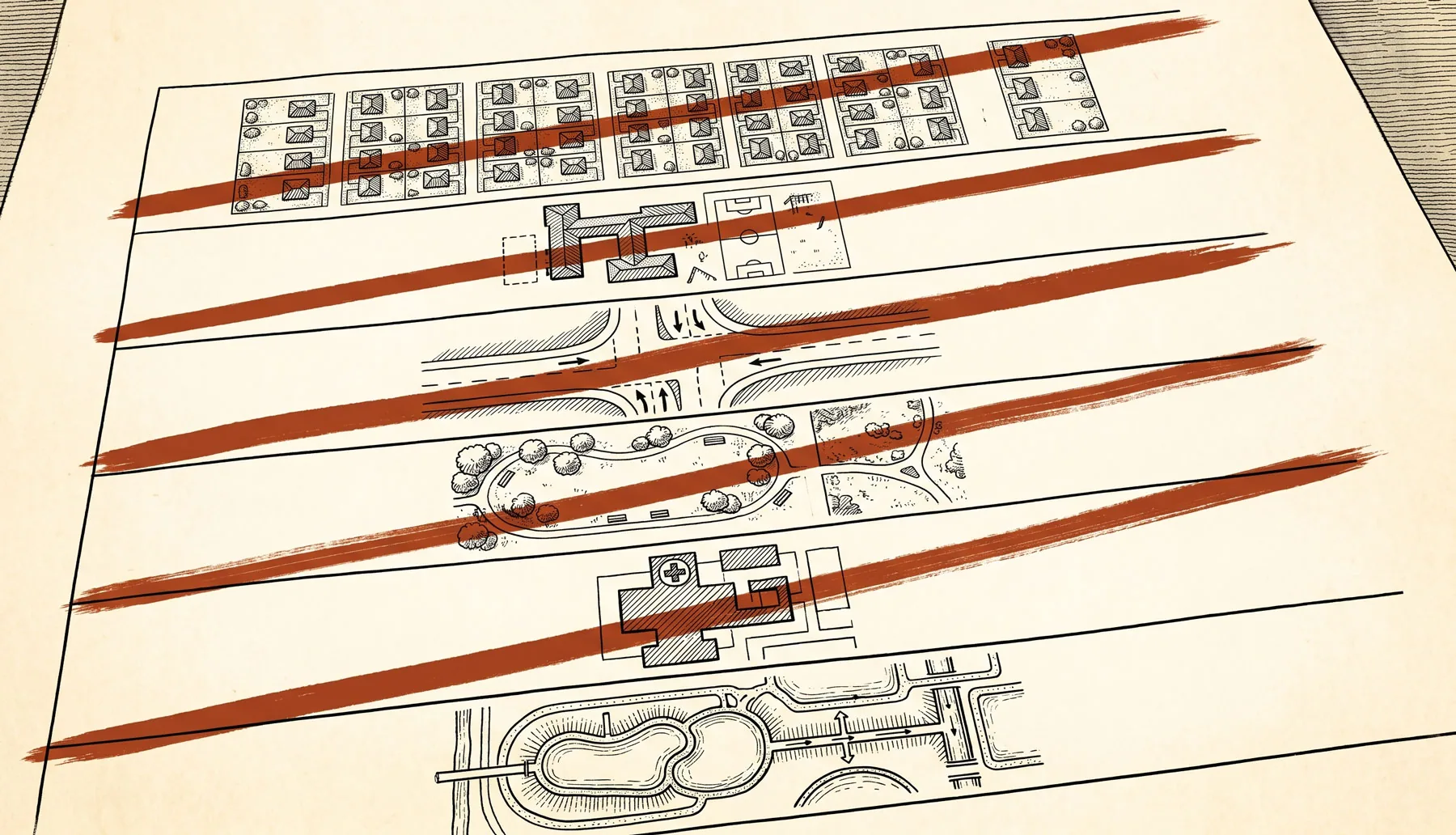
When a developer gets planning permission for a housing scheme, two things happen alongside it. The council attaches binding obligations requiring the developer to deliver affordable homes, fund school places, widen a junction, or lay out open space. Those are Section 106 obligations. Separately, the developer may also pay a fixed charge per square metre of new floorspace into a council pot for strategic infrastructure. That is the Community Infrastructure Levy, or CIL. Together, these are what planners call "developer contributions." They exist because development creates demand. More houses mean more children needing school places, more cars on the road, more pressure on the GP surgery, more sewage in the system. Someone has to pay for the capacity to handle that demand, and S106 and CIL are the mechanisms through which that is supposed to happen.
Development creates demand. More houses mean more children needing school places, more cars on the road, more pressure on the GP surgery, more sewage in the system. Someone has to pay for the capacity to handle that demand.— The Editor · Ground Level, June 2026
The system works best when development is planned through a Local Plan with a coordinated infrastructure strategy. It works worst when multiple smaller schemes come forward piecemeal around a settlement, each assessed individually, none large enough to trigger the major upgrade the area needs. The junction doesn't get widened. The school doesn't get expanded. Each scheme pays a contribution into a pot, and by the time the pot is large enough the community has been living with inadequate infrastructure for years.
CIL compounds this. Unlike S106, which must be spent on what the agreement specifies, the strategic portion of CIL (up to 80% of receipts) can be spent anywhere in the charging authority's area on whatever infrastructure the council prioritises. A village absorbs 200 new homes. The CIL from those homes funds a school extension on the other side of the district. Only the neighbourhood portion (15%, or 25% where a neighbourhood plan has been made) must be spent in the parish where the development took place. The rest goes into a district-wide pot. The community that accepted the development is not guaranteed to see the infrastructure it needs as a result.
In 2022/23, the two mechanisms raised approximately £5.5 billion across England. In 2023/24, Section 106 alone delivered roughly 27,700 affordable homes, accounting for 44% of all affordable housing in the country. By 2024/25, that share had fallen to 36%, the lowest since 2014/15. Around 17,400 affordable homes are currently sitting built or consented with no housing association willing to buy them (NAO, Improving local areas through developer funding, June 2025; MHCLG, Affordable housing supply in England, 2024 to 2025).
This explainer sets out how each mechanism works, how they interact on a single site, and why both are in trouble.
Section 106.
Section 106 of the Town and Country Planning Act 1990 is the legal basis for planning obligations. It allows a council to require a developer, as a condition of receiving planning permission, to do specific things. The Act limits those things to four categories: restricting how the land is used, requiring specified works on or over the land, requiring the land to be used in a specified way, or requiring payment of money to the council. Anything outside those four categories has no legal basis.
Three further tests restrict what councils can ask for. Under Regulation 122 of the CIL Regulations 2010, any obligation must be necessary to make the development acceptable in planning terms, directly related to the development, and fairly and reasonably related in scale and kind. These tests are repeated in NPPF paragraph 58. They exist to prevent councils from treating planning permission as a general-purpose revenue source.
The obligations are set out in a legal document. A Section 106 agreement is a deed signed by both the developer and the council. A unilateral undertaking is signed only by the developer and is commonly used at planning appeals, where the council may refuse to negotiate. Either way, the obligations run with the land. When the site is sold, the new owner inherits them. This matters because, as the earlier article on viability and design set out, sites frequently change hands between outline permission and construction.
In practice, S106 pays for most of England's affordable housing, but only on larger schemes. The NPPF states that affordable housing should not be sought on sites of fewer than 10 homes (or under 0.5 hectares). In designated rural areas, including National Parks, National Landscapes and certain smaller parishes, councils can set a lower threshold of 5 units. Above the threshold, the local plan sets the percentage, typically 30% to 40% depending on the area. At least 10% of homes on major sites should be available for affordable home ownership such as shared ownership or discounted market sale. On Grey Belt sites released from the Green Belt under the December 2024 NPPF, the Golden Rules require 50% affordable housing with no viability opt-out, the highest requirement in national policy. In 2023/24, S106 funded roughly 27,700 affordable homes. It also funds education contributions (typically a per-dwelling sum towards primary and secondary school places), highway improvements, public open space, health facilities, and increasingly ecology and biodiversity mitigation. The total value of S106 and CIL combined was around £7 billion in 2018/19 and approximately £5.5 billion in 2022/23, the decline reflecting lower housebuilding volumes and tighter viability margins (NAO, June 2025).
Get the dispatch.
Long-form, data-first, independent. Housing, planning and infrastructure reporting delivered free to your inbox.
The Community Infrastructure Levy.
CIL works differently. It is a fixed tariff per square metre of new floorspace, set by the council through a published charging schedule. The rate is examined in public before it takes effect. Once adopted, it is non-negotiable. The developer cannot argue it down through a viability assessment on a specific site.
CIL funds strategic infrastructure: roads, schools, flood defences, health facilities. The council publishes an annual Infrastructure Funding Statement setting out what it has collected and how it has spent or allocated the money.
One feature of CIL matters to parish and town councils. Where CIL is in force, 15% of receipts from development in a parish area are passed directly to the parish council. Where a neighbourhood plan has been made, that rises to 25% with no cap. This is real money in some areas. It is also the only developer contribution that goes directly to the most local tier of government.
The Mayoral CIL in London shows the mechanism working at its largest scale. Two rounds of Mayoral CIL, in force since 2012 and 2019, have raised roughly £1.5 billion towards the Elizabeth line. Rates range from about £29 per square metre in outer boroughs to £185 per square metre for commercial floorspace in central London.
Despite these advantages, only 52% of English councils had adopted a CIL charging schedule by November 2024. Setting one is expensive and evidence-heavy. In lower-value areas, any positive rate risks tipping marginal sites into unviability. Some councils prefer to keep their negotiating leverage in Section 106 rather than absorbing developer headroom with a fixed tariff. And many paused while the previous Conservative government was proposing to replace CIL with a single Infrastructure Levy, a proposal Labour scrapped in July 2024.
One critical limitation: CIL cannot fund affordable housing. That stays entirely within Section 106. There is even a mandatory exemption from CIL for social housing under Regulation 49.
How they work together on a single site.
On a major housing scheme where the council has adopted CIL, both mechanisms apply in parallel. The developer pays CIL per square metre of new floorspace into the council's general infrastructure pot. Separately, the developer signs a Section 106 agreement delivering on-site affordable housing and site-specific mitigation: the school contribution for this development, the junction improvement that this development makes necessary, the biodiversity net gain that this development requires.
Affordable housing sits entirely on the S106 side. Strategic infrastructure sits primarily on the CIL side, though since 2019 the two can fund the same item if the Regulation 122 tests are met. The old pooling restriction, which had limited S106 to five contributions per infrastructure item, was abolished on 1 September 2019.
Older permissions may have S106 only. CIL liability is triggered at the point of planning permission (or at reserved matters for phased outline consents). If the council had not adopted a charging schedule at that point, there is no CIL. The development runs on S106 alone. The 48% of councils that have never adopted CIL still run on S106 for everything. This is why some developments near each other carry different obligations: it depends on when the permission was granted and what the council had in place at the time.
How viability becomes a battleground.
The financial viability assessment is the mechanism through which S106 obligations get reduced after a scheme is consented. A developer submits an appraisal arguing that the scheme cannot bear full obligations while still delivering the 15% to 20% profit margin that Planning Practice Guidance treats as the benchmark for a deliverable scheme. The affordable housing quota comes down. Infrastructure contributions shrink.
The standard narrative blames developers for gaming the system. The reality is messier. Councils also drive up scheme costs through the negotiation process. Planning officers can load schemes with requirements that reflect personal design preferences or departmental aspirations rather than adopted policy. Conditions get attached that add cost without adding value. Consultees from highways, ecology, heritage, and drainage each add their own requirements, sometimes conflicting with each other, rarely coordinated, and almost never costed as a package before the scheme is assessed for viability. By the time the full obligation schedule is assembled, the cumulative burden may be more than the scheme can bear. The viability assessment is then used to strip things back, and what gets stripped is usually the affordable housing because it is the largest single cost and the most negotiable.
The result is a system where both sides contribute to the problem. Developers submit appraisals built on assumptions that favour their margin. Councils lack the specialist expertise to challenge those assumptions effectively. The NAO's June 2025 report found an "imbalance in skills and experience" between councils and developers, with 97% of planning departments reporting skills gaps. Shelter's 2017 study found that where viability assessments were used, 79% of policy-required affordable homes were lost. Neither finding tells the whole story. The system wastes enormous resources on both sides arguing over numbers that are shaped by conflicting aspirations, incomplete coordination, and a process that incentivises each party to overstate its position.
The most visible current example is the Aylesham Centre in Peckham, where Berkeley Homes cut its affordable housing offer in December 2024 from 270 homes (35%) to 77 (8% by unit count), a 71% reduction on viability grounds. The scheme is now subject to a planning inquiry.
The December 2024 NPPF tightened the rules. Schemes that comply with policy requirements are now presumed viable. Viability assessments must be made publicly available. The price a developer paid for the land cannot be used as a reason for non-compliance. The December 2025 draft NPPF, consulted on until March 2026, proposes going further: limiting viability assessments to cases where circumstances are unforeseen and standardising the developer profit margin at 17.5%. Whether these changes fix the underlying dysfunction or just move the argument to a different stage of the process remains to be seen.
As the earlier article on what "affordable" actually costs set out, what gets cut through viability negotiations is labelled "affordable housing" but the dominant tenures within that label, affordable rent at 80% of market and shared ownership, are not affordable on local earnings. The social rent component that would actually house people from the waiting list is already a fraction of the total. Viability negotiations reduce a quota that was inadequate to begin with.
The 17,400 homes nobody will buy.
The most acute problem now is different from viability. Affordable homes are being built and no housing association will purchase them.
A Home Builders Federation survey of 31 housebuilders in October 2024 identified 17,432 Section 106 affordable units with detailed consent but no registered provider to take them. Roughly 900 were sitting completed and empty. A further 8,500 were under construction or due to start within a year with no buyer lined up.
The causes have stacked on top of each other since 2022. Higher interest rates have pushed up housing association borrowing costs. The Building Safety Act and Awaab's Law are pulling billions out of development budgets and into remediation of existing stock. Rent caps of CPI plus 1% have constrained business plans. The Future Homes Standard adds further capital requirements, one of several regulatory costs that are quietly reshaping the economics of housebuilding and which will be examined in a separate article. A Savills survey in June 2024 found more than half of England's top 30 housing associations had stopped or scaled back their Section 106 acquisitions.
The earlier article on what "affordable" actually costs described for-profit registered providers backed by institutional capital, companies like Sage Homes (owned by Blackstone), entering the market to buy S106 affordable housing as a commercial investment. Even these providers are not buying at anything close to the scale needed to clear the backlog. The market is so broken that neither traditional housing associations nor institutional investors are acquiring enough units. The cascade mechanism then risks converting those homes to market sale, at which point a different kind of institutional investor may pick them up as build-to-rent. The people on the waiting list lose out at every stage.
The government launched a Section 106 Affordable Housing Clearing Service in December 2024, run by Homes England. It is a matching platform: developers list unsold units, and registered providers can bid. By October 2025, roughly 800 units had been listed against a need of 17,400.
On 28 January 2026, Housing Minister Matthew Pennycook issued a Written Ministerial Statement describing the situation as an emergency. His policy document, A Roadmap for Section 106 Delivery in England, introduced a time-limited renegotiation power. Councils are now expected to allow developers to vary Section 106 agreements where units remain unsold, provided the developer has listed them on the Clearing Service for at least six weeks. If no buyer comes forward, the tenure cascades downward. Social rent becomes affordable rent. Affordable rent becomes shared ownership. Shared ownership becomes discounted market sale or full market sale with a commuted sum paid to the council.
The practical consequence is this. A community that accepted a development on the basis that it would include affordable homes may find those homes converted to market housing with a payment to the council in lieu. The development happened. The obligation is being unwound after the fact. The people on the waiting list are no closer to a home.
The government has coupled this with investment: a £2.5 billion low-interest loan facility for housing associations, a new £39 billion Social and Affordable Homes Programme 2026-2036, and expanded powers for councils to use Right to Buy receipts to purchase unsold units directly. Some councils have already acted. Southwark bought around 380 such homes. Thanet bought 31 on a Bellway site in Margate. Whether this scales fast enough to prevent a structural loss of social housing through cascade conversions is an open question.
The levy that died.
The previous Conservative government attempted to replace both Section 106 and CIL with a single Infrastructure Levy, enacted in the Levelling-up and Regeneration Act 2023. The IL would have been mandatory, calculated as a percentage of gross development value at completion, and rolled out over ten years.
Roughly thirty housing, planning and local government bodies wrote jointly to oppose it, warning it would reduce affordable housing. GLA modelling suggested between 4,500 and 10,000 fewer affordable homes over three to five years on London schemes alone. Labour scrapped it in Angela Rayner's first Written Ministerial Statement on 30 July 2024. The LURA provisions remain on the statute book but unimplemented, with no draft regulations and no pilot authorities. The system stays as it is: two mechanisms, patched rather than replaced.
The Planning and Infrastructure Act 2025, which received Royal Assent on 18 December 2025, does not revive the Infrastructure Levy. Its main developer-contribution innovation is the Nature Restoration Fund, under which developers can pay into a pooled fund in lieu of site-specific ecology mitigation. The mitigation funded by the pool does not have to benefit the site or area where the ecology was removed. It can be delivered anywhere within the relevant Environmental Delivery Plan area. This follows the same pattern as CIL: the community that absorbs the development is not guaranteed to see the environmental benefit. The rest of the S106 and CIL system continues unchanged.
Where the target meets the ground.
Section 106 and CIL are where the housing target meets the ground. The standard method sets the number. The five-year supply test enforces it. The Local Plan allocates the sites. The viability assessment determines how much the developer actually pays. And S106 and CIL determine what the community gets in return.
When the system works, new housing funds new infrastructure and provides homes for people who could not otherwise afford them. When it breaks, the housing arrives and the promises made to secure consent are renegotiated, cascaded, or left unspent in a council account. For much of England right now, the system is doing more of the latter than the former.