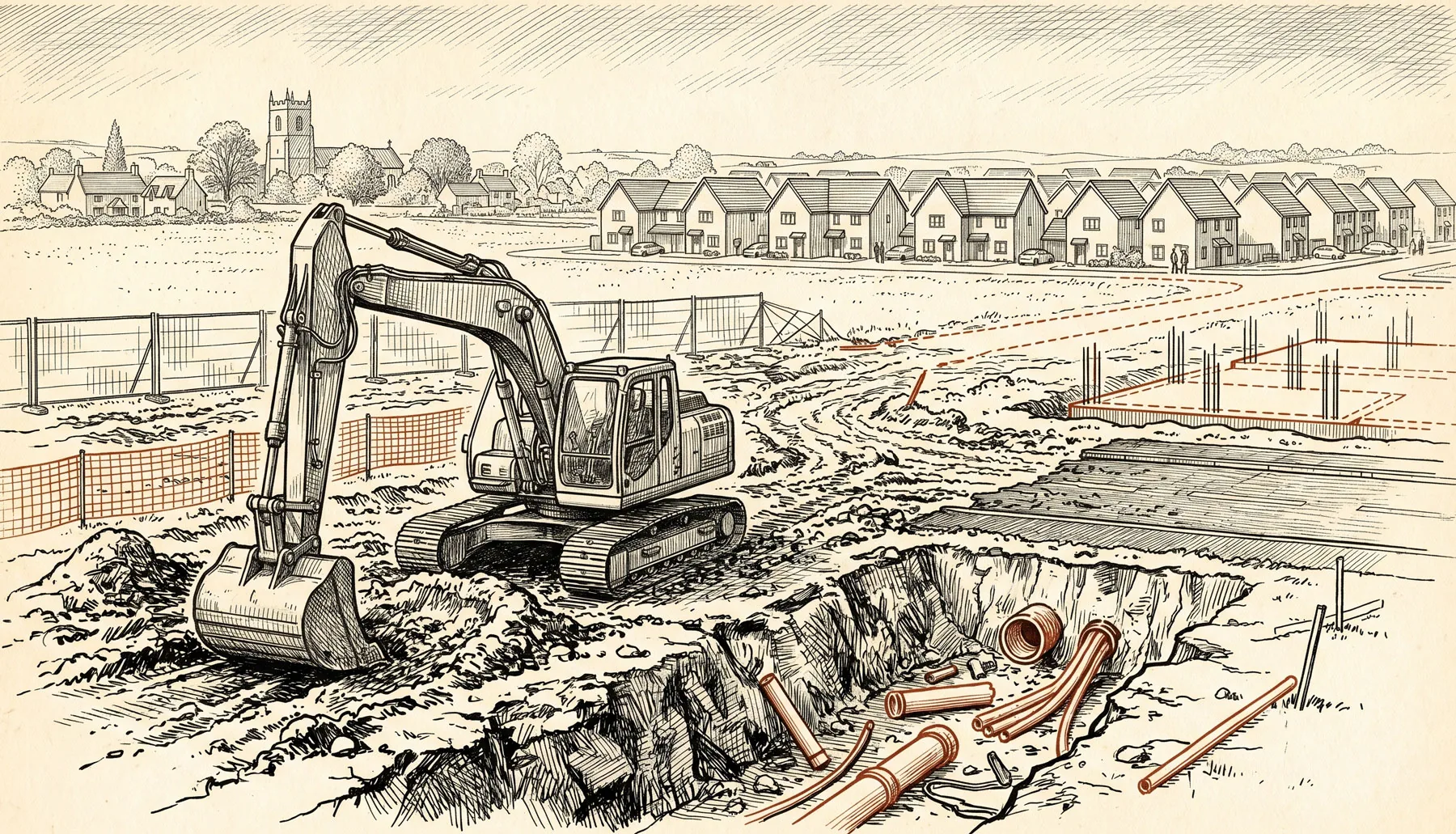
Every new home needs infrastructure. Ten houses on the edge of a village still need water, drainage, a road connection, and enough capacity in the local school and GP surgery. Two hundred homes need all of that plus potentially a new junction, expanded sewerage, and education contributions running into hundreds of thousands of pounds. Two thousand homes may need a new primary school, a GP surgery, upgraded sewage treatment, and road improvements costing tens of millions. The scale varies. The problem does not: somebody has to provide the infrastructure, somebody has to pay for it, and somebody has to make sure it arrives before the community is overwhelmed.
In England, each piece of that infrastructure has a different legal regime and a different responsible body. The water company handles pipes and sewers. The county highways authority handles roads. The county education authority handles school places. The Integrated Care Board handles GP provision. The electricity and gas networks are increasingly run by private independent operators most residents have never heard of. The local planning authority sits in the middle, coordinating all of it, but delivering almost none of it directly.
This fragmentation is the central problem. Nobody owns the whole delivery chain. Infrastructure is funded piecemeal through Section 106 obligations and the Community Infrastructure Levy, as the earlier article on those mechanisms set out, but the money flows only as homes are built. The infrastructure needs to exist before or alongside the development, not years after the first families have moved in. On schemes large enough to need new capacity, it rarely does.
Water, sewerage, and the biggest blocker in the system.
Water and sewerage are the most tightly regulated parts of the infrastructure picture, and they are now the single biggest obstacle to housing delivery in England.
The regional water company has statutory duties under the Water Industry Act 1991 to supply water and to provide sewerage. Developers build the on-site network and offer it for adoption under a Section 104 agreement, paying a bond of around 10% of construction cost. Once adopted, the water company maintains it. The process is governed by Water UK's Code for Adoption, which replaced the old Sewers for Adoption guidance in April 2020.
The legal position on connections is striking. Under Section 106 of the Water Industry Act 1991 (a completely different S106 from the planning one), developers have a statutory right to connect to the public sewer. In Barratt Homes v Dwr Cymru (2009), the Supreme Court confirmed that a water company cannot refuse a connection on grounds of inadequate capacity. The burden of handling new flows falls on the undertaker. In practice this means water companies cannot block development outright, but they can and do slow it down through modelling disputes, phasing requirements, and lobbying councils to impose occupancy conditions that prevent new homes being lived in until upgrades are complete.
The result is a system where the developer has the legal right to connect, the water company has the legal duty to cope, and neither has the money or the incentive to upgrade capacity before the houses arrive. Storm overflow spills hit 3.6 million hours in 2024. The HBF's September 2025 report documented at least 30,000 homes stalled because water companies could not accept the flows. In Oxford, Thames Water's sewage works bottleneck held back an estimated 18,000 homes until a deal in October 2025 committed to an interim upgrade by 2027.
Layered on top of this is the nutrient neutrality crisis. Since 2019, Natural England has required developments draining into protected habitats to demonstrate that they add no additional nutrient load. By 2022 the regime covered 74 local planning authorities across 27 catchments, from the Solent to the Somerset Levels to the Stour in Kent. The HBF estimates around 160,000 homes were frozen at the peak. The Planning and Infrastructure Act 2025 attempts to fix this through Environmental Delivery Plans and the Nature Restoration Fund, under which developers can pay into a pooled fund rather than mitigating site by site. Natural England notified its intent to prepare 16 EDPs for nutrient catchments in December 2025. The first consultations are due in 2026. Whether the new regime works at scale is untested.
The Cambridge water crisis is the sharpest case study. In 2022 and 2023 the Environment Agency formally objected to multiple housing schemes on the grounds that abstraction from the chalk aquifer was already damaging water bodies. Around 9,000 homes were effectively frozen. The government responded with a water scarcity group, a retrofit pilot, and plans for a pipeline and reservoir targeted for the late 2030s. In October 2025 Cambridge City Council had to declare a formal water emergency after Anglian Water raised new capacity objections to developments that could unlock 5,600 homes at North East Cambridge. The homes are planned. The water to serve them does not yet exist.
Get the dispatch.
Long-form, data-first, independent. Housing, planning and infrastructure reporting delivered free to your inbox.
Roads, adoption, and who pays when the council won't.
New estate roads are designed by the developer's consultants against the local highway authority's standards. National guidance is the Department for Transport's Manual for Streets (2007), which advocates narrower carriageways, 20mph design speeds and shared surfaces. Many county highways teams still apply wider, older standards derived from the 1970s Design Bulletin 32 or the Design Manual for Roads and Bridges, which was written for motorways. Manual for Streets 3 has still not been published: a closed draft circulated in early 2025 with no confirmed publication date.
Developers offer new roads for adoption via a Section 38 agreement under the Highways Act 1980. Works to the existing public road, such as new junctions or traffic signals, use a Section 278 agreement. Neither is legally compulsory. Developers can keep roads private.
An HBF Freedom of Information survey published in 2024 found that across more than 1,000 new developments of ten or more homes over three years, only 10% of sites had roads adopted by the highway authority. 97% of sewers and 98% of SuDS were also unadopted. A third of councils had adopted no roads at all. Bond costs demanded by councils before adoption had risen more than ten-fold at the top end between 2017 and 2023, which, combined with council reluctance to take on future maintenance liabilities, has essentially privatised estate infrastructure.
This is the "fleecehold" problem. The Competition and Markets Authority's housebuilding market study, published in February 2024, found that 80% of new homes sold by the eleven largest builders came with estate management charges. Up to 1.75 million English homes are now on privately managed estates where residents pay charges on top of council tax for roads, drainage and open space the council was never going to adopt. The Leasehold and Freehold Reform Act 2024 introduced transparency and tribunal rights for these homeowners, but the estate management provisions have not yet been commenced. Government consultations on ending fleecehold were extended in December 2025 with a closing date of March 2026.
The practical consequence: residents pay council tax for services their council does not provide on their street, plus a management fee to a private company for the roads, drainage and green spaces in front of their homes. Sherford in Devon is a flagship example. Over 1,300 homes occupied, roads still unadopted in 2025, and residents unable to get price breakdowns from the management company even when local councillors asked.
Schools, GPs, and the timing gap.
Education contributions are calculated by the county or unitary council using per-dwelling formulae. The Department for Education's August 2023 guidance introduced a standardised calculation: pupil yield per phase, multiplied by a cost-per-place multiplier, multiplied by year groups. As a rough guide, up to around 500 homes will expand an existing school. Above that, a new one-form-entry primary is triggered. Large strategic sites of 1,500 homes or more typically need a new secondary.
The timing gap is structural. Section 106 money flows only as units are built and occupied, often tied to trigger points at the 100th or 200th occupation. The school has to be designed, procured and constructed, which takes years. The first residents move in before a school can be completed. In Nantwich, Kingsbourne Primary was promised for September 2024 and was still unbuilt in February 2025. At Ladden Garden Village in Yate, two permitted primary schools remain undelivered. In two-tier areas the problem is compounded because CIL is collected by the district planning authority while the school-places duty sits with the county, and the two bodies do not always coordinate.
GP provision is harder still. GP practices are private partnerships on NHS contracts, not public institutions. They operate out of premises typically owned by commercial healthcare investors such as Assura or Primary Health Properties. Integrated Care Boards, which replaced Clinical Commissioning Groups in July 2022, commission primary care but do not hold capital budgets for new premises. The ICB's population-based funding follows the Office for National Statistics' mid-year estimates, not planning pipelines, so the money reliably arrives years after the residents.
Courts have made the legal position worse. In the Hampshire Hospitals judgment in 2024 the High Court cast serious doubt on whether NHS S106 contributions pass the Regulation 122 tests of being necessary to make development acceptable, because healthcare is a statutory NHS function funded through general taxation. Planning obligations for health now face real legal uncertainty.
The consequences are visible at almost every major strategic site. At Northstowe in Cambridgeshire, where the first residents moved in in 2017 and 10,000 homes are planned, the GP surgery is now delayed to 2028. At Ebbsfleet Garden City in Kent, the proposed super-surgery for 20,000 patients has been postponed on financial grounds. At Cranbrook in Devon, the original GP contractor walked away in 2019, and NHS Devon was still running a procurement exercise in mid-2025. A community that accepted a development on the basis that it would include a surgery finds itself driving to the next town for an appointment a decade later.
The hidden utility market.
One of the least-understood shifts in how new housing gets power and gas is the rise of Independent Distribution Network Operators (IDNOs) and Independent Gas Transporters (IGTs).
Traditionally, electricity on a new estate was installed by the regional monopoly Distribution Network Operator: UK Power Networks in the south east, SSEN in the south, Northern Powergrid in the north east, and so on. Gas was installed by one of the four Gas Distribution Networks. Since 2004, Ofgem has licensed independent alternatives. Today there are around 13 IDNOs and 15 IGTs, and the Independent Networks Association says its members connect over 80% of new homes in Great Britain.
The basic mechanism is this. A developer building a new estate can contract with an independent provider to install the electricity or gas network rather than using the incumbent DNO. The IDNO or IGT then adopts and owns that network, operating it under an Ofgem licence with the same service standards as the regional monopoly. Ofgem regulates IDNOs and IGTs to the same rules as the incumbents. Residents can switch energy supplier as usual. The network operator is the one thing they cannot change.
Research cited by one of the larger IDNOs found 65% of industry decision-makers had never heard of the sector, and residents generally have no idea their local power or gas network is run by a company other than the regional monopoly. Service quality is ostensibly identical: the same 24/7 response obligations, the same emergency numbers. The emerging question is how smaller independent networks handle future reinforcement as households add EV chargers and heat pumps.
There is an irony in the trajectory. IDNOs were licensed to introduce competition into electricity distribution. But once an IDNO owns the network on a particular estate, there is no competition at all. Residents cannot switch network operator. And the sector is consolidating. Smaller IDNOs are being absorbed by larger ones, which are in turn being acquired by infrastructure investment funds. The number of entities controlling new-build electricity and gas networks is shrinking. The old DNO monopoly was regional and publicly visible. The emerging IDNO landscape risks replacing it with something estate-by-estate and invisible.
What matters for the reader is that the electricity and gas network serving their new home is very likely owned and operated by a company they have never heard of, regulated by Ofgem, and functioning under the same rules as the regional monopoly. It works. Most people will never notice the difference. Whether that remains true as the sector consolidates further and the demands on networks grow is worth watching.
Why infrastructure follows housing.
The system has a built-in sequencing problem. Developer money does not arrive until construction begins. It cannot fund the infrastructure that needs to exist before the first resident moves in. The school cannot open without pupils to justify it. The GP surgery cannot open without a patient list. The junction cannot be upgraded without funding from the development that will generate the traffic. Everything arrives late by design.
The government's attempt to break this cycle was the Housing Infrastructure Fund, launched in 2017 with a headline £5.5 billion. It funded roads, utilities and site preparation up front so that development could follow. By January 2024, only £1.3 billion of the £4.2 billion actually committed had been spent. Work had started on fewer than one in ten of the promised homes. Sixteen projects were cancelled, totalling around £540 million and 42,000 homes. The fund closed with no direct successor.
The cases where infrastructure did arrive before housing share a common feature: a single accountable delivery body with front-loaded central government money. Ebbsfleet Garden City, run by a development corporation, received roughly £200 million up front and delivered a rail station, utilities spine, primary school and junction upgrades ahead of mass occupation. Barking Riverside capped occupation at 1,200 homes until the Overground station was open. Eddington in Cambridge, built by the university, delivered a primary school and health centre before most housing arrived.
The cases where it failed share the opposite feature: fragmented responsibility with no single body holding both the risk and the money. Stroud's Local Plan assumed 85% of the M5 junction upgrade cost would come from central government, with no commitment from anyone to provide it. The plan was directed for withdrawal. Northstowe planned 10,000 homes but the GP surgery will not open until 2028, eleven years after the first residents moved in. Sherford has 1,300 homes occupied with roads still unadopted. In each case, the housing arrived. The infrastructure did not.
The homes get built. The infrastructure to support them does not keep pace. The targets generate the numbers. The five-year supply test forces the permissions. The S106 and CIL extract the money. And the community waits.— The Editor · Ground Level, June 2026
What needs to change.
The pattern across water, schools, health and highways is consistent. Infrastructure delivery fails when responsibility is fragmented across bodies with different funding cycles and different priorities. It succeeds when a single entity owns the whole delivery chain with the money to act before the houses are sold.
The Planning and Infrastructure Act 2025 recognises this for ecology, where pooled mitigation through the Nature Restoration Fund replaces site-by-site negotiation. It recognises it for strategic planning, where new Spatial Development Strategies will coordinate across council boundaries. It does not yet recognise it for schools, GPs, sewerage capacity or junction upgrades, where the fragmentation is deepest and the timing mismatches are worst.
Councils are sitting on roughly £8 billion of unspent developer contributions. Schools are opening years after the children arrive. GP surgeries are being delayed into the next decade. Roads are being left unadopted while residents pay management fees on top of council tax. Water companies cannot refuse connections but cannot cope with the flows. And the money to fix all of it arrives only after the problem has already been created.
The earlier articles in this series explained how housing targets are set, how they are enforced, and how the contributions are negotiated. This article explains why, even when the system works as designed, the infrastructure still arrives late. The targets generate the numbers. The five-year supply test forces the permissions. The S106 and CIL extract the money. And the community waits for the school places, the surgery capacity, and the junction upgrade that were promised when the development was approved. The homes get built. The infrastructure to support them does not keep pace.