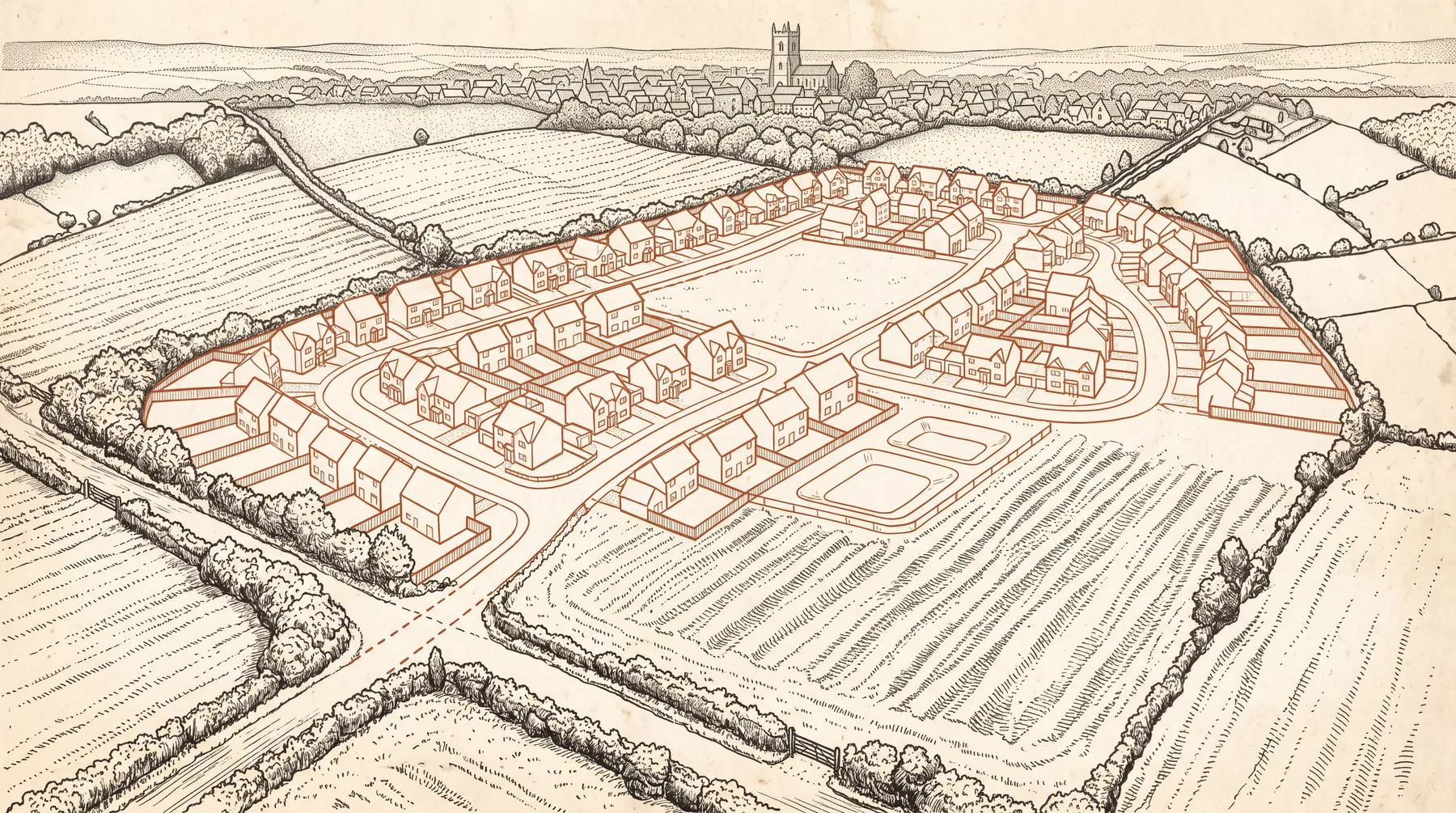
When Inspector Rachel Hall allowed 54 homes north of The Wern on 15 June 2026, the bleak part was not the loss. It was the manner of it. The council had not been careless and it had not argued badly. The Inspector agreed with a good deal of its case. She accepted the scheme would harm the character of the area. She accepted it would harm the setting of a listed building. Then she allowed it. To a councillor who has just watched a ten-year argument lost in an afternoon, the conclusion looks obvious. Objecting is theatre.
It is not, but the Wern should change how a council objects rather than whether it bothers. Read the decision closely and it stops being a verdict on the whole system and turns into something more useful. It is a map of which arguments carried weight, which collapsed, and where a town council's effort is simply thrown away. What follows is that map, with the Wern as the worked example and Cotswold, a district that has dropped to 1.8 years of housing land supply, as the setting. The lessons travel to any authority in the same position.
Lost on weight, not principle
Begin with what the council won, because the decision letter is clear about it. On character, the Inspector found the development would harm the area and wear away its sense of rurality, in conflict with three Local Plan policies and the neighbourhood plan (paragraph 13). On heritage, she found genuine harm to the setting of Butler's Court, the Grade II listed farmhouse (paragraph 23). These were not arguments she dismissed. They were findings she made.
The council still lost, and the reason is set out without much dressing. The district can show only 1.8 years of housing land against a five-year requirement, a shortfall the Inspector put at around 3,493 homes (paragraph 65). That engages the tilted balance in the National Planning Policy Framework, under which permission has to be granted unless the harm significantly and demonstrably outweighs the benefits. She gave the character harm moderate weight. She gave the heritage harm considerable importance and weight. And she still concluded, at paragraph 67, that the harm did not significantly and demonstrably outweigh the benefits. The homes were allowed.
So in a district below five years' supply, the fight is not about the principle of growth. That argument is gone before a councillor draws breath. It is a fight about weight. Principle cannot be shifted. Weight can.
The trap, laid bare
One paragraph in the Wern decision deserves to be read aloud at a council meeting, because it exposes the machine more plainly than any campaigner could. At paragraph 65 the Inspector records that other housing schemes have come forward in Lechlade, among them an application for 150 homes elsewhere in the town. Then she sets it aside in a line. Even if those 150 homes were built, she says, a substantial shortfall across the district would still remain.
Follow that to its end. The shortfall is so large that no single site can close it. If no single site can close it, no single site's harm can ever be the thing that tips the balance. If no harm can tip the balance, the presumption never switches off, and the next application arrives already tilted in the developer's favour. The shortfall stops being a target anyone is expected to hit and becomes a permanent reason to say yes. One decision waves through 54 homes while pointing at the next 150 and calling them too small to matter against the very shortage used to justify the first.
There is a quieter unfairness underneath it, and the Council's own evidence spells it out. Cotswold's preferred development strategy concentrates growth on the settlements that sit outside the Cotswolds National Landscape, because national policy limits what can be built inside it. Lechlade is one of the few principal settlements marked as outside the designation. So the Council's own Development Strategy Options report loads new housing onto Lechlade not because the land is well suited to it, but because the town lacks the protective label that shields most of the district. The bats, the conservation area, the listed buildings, the best farmland, none of that registers on the strategic map, because the map mostly sees one constraint. A town gets picked because, on paper, it looks empty.
A presumption is not a verdict
Here is the part the Wern, on its own, does not tell you. The tilted balance can be beaten, and councils have beaten it.
In 2023 Wokingham Borough Council defended its refusal of a 200-home scheme at an eight-day public inquiry, with only 3.95 years of housing land supply and the tilted balance fully engaged. The Inspector dismissed the appeal. The council's argument, which the Inspector accepted, was that the tilted balance must not be applied mechanically, and that an Inspector has to use planning judgement about why the shortfall exists and whether this particular site is the right way to meet it. He found that a 200-home scheme in the countryside, in conflict with the spatial strategy, was not the most sensible or appropriate way to address the shortage, and that the harm significantly and demonstrably outweighed the benefits. It is not an isolated result. Inspectors have dismissed large housing appeals at Bracknell on landscape and visual harm despite the supply shortfall, and refusals at Gretton and Flitch Green were upheld all the way to the Court of Appeal.
Be careful with the comparison, because honesty is the whole point of a piece like this. Wokingham was at 3.95 years and could show it was actually over-delivering against its plan. Cotswold is at 1.8 years and genuinely under-delivering, which is a far weaker hand. The benefits side of the scales is heavier here, so the harm a council assembles has to be correspondingly heavier and better evidenced. What Wokingham proves is not that these fights are easy. It proves the tilted balance is a presumption and not a verdict, and that an evidenced case, properly run, can still win. That is a different starting point from despair.
A presumption is not a verdict. The machine that beat the Wern is not unbeatable. It has been beaten elsewhere this year, by councils that fought on the right ground.— The Editor · Ground Level, June 2026
So what actually holds
Four things, in rough order of how reliable they are.
Win it where it is actually decided. Every refusal fought one application at a time is a rearguard action against a presumption built to defeat it. The war is won in the Local Plan, because an adopted plan that demonstrates a five-year supply switches the tilted balance off across the whole district. That is the only permanent fix, and the window is open now. Cotswold is aiming to submit its Local Plan Update by the end of 2026, with the decisive Regulation 19 stage expected during the year and town and parish councils invited into the conversation about where sites should go. Miss that window and local government reorganisation across Gloucestershire could push an up-to-date plan back by years. There is a craft to using the hour well. At Regulation 19 only the points that go to a plan's soundness or its legal compliance survive to examination, so pitch everything in those terms. Is the plan justified by the evidence. Is it effective. Is it deliverable. A plain objection counts for nothing here. A soundness representation counts for a great deal, and it is the one arena where a town council can argue a named site is undeliverable or unsuitable and actually change what gets allocated.
Fight the site, not the principle. This is the Wokingham move. Do not argue that the town does not want the homes, because the tilted balance is designed to roll straight over that. Argue, on evidence, that this particular field is the wrong way to meet the need: that the harm is real, specific and weighty, and that the benefits do not outweigh it once that harm is properly counted. Landscape, the character of an approach into a historic town, highway safety, the sustainability of a car-dependent location, the loss of good farmland, all of it adds weight if it is evidenced rather than asserted. And here is the distinction that matters most, because it is easy to get wrong. Planning conditions are not the enemy. Conditioning a genuine, resolvable detail, the exact level of a drainage basin, a survey of a culvert, is the system working as it should, and a council that tries to block every condition will rightly be ignored and may face a costs award. The point is narrower. There is a difference between a detail that can properly be settled later and a fundamental question that goes to whether the development is acceptable at all. You cannot condition away a harm you have not yet measured. Where the baseline information is so incomplete that the harm cannot even be assessed, or where a scheme cannot lawfully proceed without something the applicant has not got, that is not a matter for a condition. It is a reason the application is not ready to be granted. Insist those questions are answered before determination, not promised after it.
Stand on the firmest ground: the hard environmental gates. Some harms are not weighed in the tilted balance at all. They sit closer to a gate. European Protected Species, such as great crested newts, are protected under the Habitats Regulations, and before granting permission the authority has to be satisfied the strict derogation tests can be met. A statutory consultee like Natural England maintaining an objection on a protected site is a different kind of obstacle from heritage harm, because it is not simply outweighed by housing need. Be honest about the limit, though, because a developer's consultant will be. Many districts, Cotswold among them, run a District Level Licence scheme for newts, which lets the authority license the impact at the same time as granting permission, and at the Wern that is exactly what happened: the newt issue was conditioned away in two lines. The newt point alone, in a district with that scheme, is usually curable. The firmer ground is what the licence does not cover. Harm to a Site of Special Scientific Interest, functionally linked land, an unresolved Natural England objection on a protected habitat, these are the matters the tilted balance cannot simply outweigh and a standing licence cannot cure.
Treat heritage as a card, not a banker. In a town with listed buildings and a conservation area but no National Landscape cover, heritage is the strongest single planning-balance card, because its weight is set by statute rather than taste. Sections 66 and 72 of the Listed Buildings Act require considerable importance and weight to be given to harm to a listed building or conservation area. But the Wern is a warning against leaning on it too hard. The council there ran the argument that heritage harm gave a strong reason to refuse, which would have switched the tilted balance off. The Inspector rejected it at paragraph 64: because the harm to Butler's Court was at the lower end of less than substantial, it was outweighed by the benefits, and the off-switch did not apply. Conceding or proving heritage harm does not hand you the result. What lifts a heritage case well above the Wern's is harm that is more than minimal, and refused mitigation: where the council's own conservation officer identifies a way to reduce the harm and the developer turns it down, the harm has not been minimised as policy requires, and that refusal is a material consideration the Wern Inspector never had to weigh.
Fund the fight, and take a seat at the table. Notice what the winning councils have in common. Wokingham beat the tilted balance with a barrister, at an inquiry, with a Rule 6 party alongside it. The Wern was lost by a council whose technical objections had largely fallen away before the hearing. The difference between those outcomes is not luck, it is resourcing. A council that has resolved itself eligible for the general power of competence can lawfully pay for expert evidence and representation from the precept. The money buys evidence that keeps harm live, and it buys Rule 6 status, which makes a town council a main party to an appeal, able to receive every document, call witnesses and cross-examine the developer's. A contested housing inquiry runs into five figures, which is why pooling money across parishes and with residents' groups is the difference between turning up properly and not turning up at all. And the cheapest weapon of all is reading what the developer filed. The most damaging objections are not opinions, they are the contradictions sitting inside the applicant's own documents: a drainage design justified by data from the wrong part of the site, an ecological value quietly marked down between one report and the next, a traffic assessment modelled on places nothing like this one. Quote the developer back to the developer.
Get the dispatch.
Long-form, data-first, independent. Housing, planning and infrastructure reporting delivered free to your inbox.
What not to waste money on
Hope is only worth having if it is honest. So do not pin yours on dragging a decision like the Wern through the courts. A statutory challenge attacks the legality of a decision, a genuine error of law, not the planning merits. It runs to a strict six-week deadline and costs tens of thousands with no promise at the end. The Inspector weighed it wrong is not a ground, and most challenges fail for exactly that reason, merits dressed up as law. For a parish precept it is almost never the right call. An Asset of Community Value listing will not stop greenfield housing either, and a bare objection, however heartfelt, will keep losing to a developer who arrives with a KC. Spend the money upstream, on evidence that stays unresolved and on Rule 6, where it actually moves weight.
The answer to the numbers game
The Wern was not proof that resistance is pointless. It was proof that resistance pitched at the principle of growth, on undesignated land, with every technical objection cured before the hearing, will lose. That is a different problem, and a more fixable one, than it looks from the wrong end. The machine runs on a shortfall it has quietly decided can never be filled. You do not beat that by arguing with the shortfall. You beat it by making the individual site impossible to wave through: by getting to the Local Plan where the presumption can be switched off, by fighting whether this field is the right way to meet the need rather than whether the need exists, by standing on the environmental gates the balance cannot outweigh, and by resourcing the case the way the councils that win actually resource it.
None of it comes with a guarantee, and at 1.8 years the odds are honestly hard. But hard is not hopeless, and a presumption is not a verdict. The machine that beat the Wern is not unbeatable. It has been beaten elsewhere this year, by councils that fought on the right ground and paid for the fight.
Sources and notes
- The Wern decision: Appeal Ref 6002824, Land North of The Wern, Lechlade, Inspector Rachel Hall BSc MSc MRTPI, 15 June 2026 (appeal by Hallam Land against Cotswold District Council, application 24/03501/OUT). Findings referenced: character harm and moderate weight (paras 13, 66); harm to the setting of Butler's Court at the lower end of less than substantial but of considerable importance and weight (paras 23 to 24); drainage and biodiversity reasons resolved or withdrawn and conditioned (paras 25 to 32); heritage balance (paras 59 to 61); footnote 7 and paragraph 11(d)(i) held not to apply despite the heritage harm (para 64); the 1.8-year supply, the circa 3,493-home shortfall and the reference to the 150-home scheme (para 65); overall planning balance (paras 67 to 68).
- A council beating the tilted balance: Wokingham Borough Council, appeal by Mactaggart and Mickel for up to 200 homes at Hurst, Berkshire, dismissed 2023 at 3.95 years' supply; the council argued the tilted balance should not be applied mechanically and that the site was not the appropriate way to meet the shortfall (reported by Local Government Lawyer; council represented by Matt Lewin of Cornerstone Barristers). Also: Bracknell Forest appeals dismissed on landscape and visual harm; Gretton and Flitch Green refusals upheld in the Court of Appeal (Gladman).
- The tilted balance and the standard method: NPPF (December 2024), paragraph 11(d) and footnotes 7 and 8; Cotswold's supply fell from 7.3 to 1.8 years after the December 2024 standard-method change raised the annual target from 493 to 1,036 homes (Cotswold District Development Strategy Options Technical Report, November 2025, paras 3.4 to 3.5). A draft NPPF was out for consultation in early 2026; check current paragraph numbers before relying on them.
- Why Lechlade carries the growth: Cotswold Development Strategy Options Technical Report (November 2025), which concentrates growth on settlements outside the Cotswolds National Landscape and identifies Lechlade as outside the designation.
- Heritage duties: sections 66 and 72 of the Planning (Listed Buildings and Conservation Areas) Act 1990; East Northamptonshire DC v SSCLG (Barnwell Manor) [2014] EWCA Civ 137.
- Environmental gates: Conservation of Habitats and Species Regulations 2017 (European Protected Species and the derogation tests); Cotswold operates a great crested newt District Level Licence through NatureSpace, which can license newt impacts at the point of permission and does not cover SSSI or functionally linked land.
- Town council powers: general power of competence (Localism Act 2011); section 137 (Local Government Act 1972); Rule 6 party status (Planning Inspectorate guidance). Indicative inquiry costs from chambers and consultancy guidance and reported parish spend; get quotes.
This article is general guidance, not legal advice. On any live appeal or plan representation, take advice from a chartered planner or planning counsel.